
Sponsored

thesilverbullet
Well-Known Member
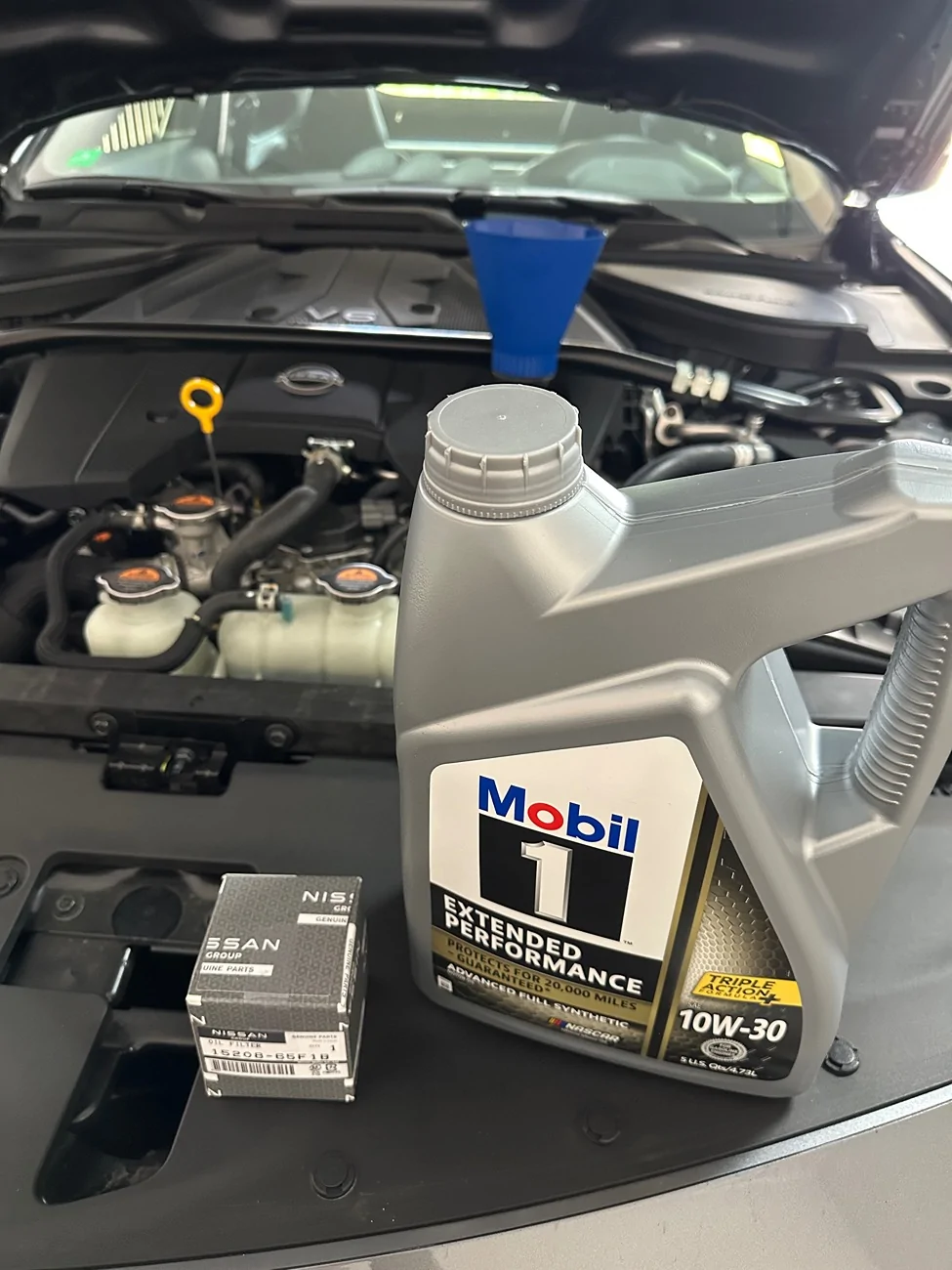
M1 @ walmart or Amazon…

socketz67
Member
Autozone and others provide oil recycling. I take it to the store, and they point me to a large tank in the back.If you change the oil yourself, is it easy to do with the new Z? Where do you dispose of the oil after you are done?
thesilverbullet
Well-Known Member
good to know retail outlets recycle. my local county trash dump recycles oil and everything else…

Zplz
Well-Known Member
Since AI is seemingly everywhere, here's what Google AI came up with concerning 0W-20.
Yes, Nissan explicitly recommends using 0W-20 oil in the Nissan Z all year round, even during a hot summer.
Unlike older vehicle manuals that included temperature-dependent viscosity charts, the factory guidelines for the modern twin-turbo VR30DDTT engine strictly specify full synthetic 0W-20 (API SP / ILSAC GF-6A) for all operating temperatures and climates.
How 0W-20 Protects in Summer Heat
While 0W-20 is the absolute standard for daily driving and keeping your factory warranty completely secure, real-world usage can create edge cases:
Yes, Nissan explicitly recommends using 0W-20 oil in the Nissan Z all year round, even during a hot summer.
Unlike older vehicle manuals that included temperature-dependent viscosity charts, the factory guidelines for the modern twin-turbo VR30DDTT engine strictly specify full synthetic 0W-20 (API SP / ILSAC GF-6A) for all operating temperatures and climates.
How 0W-20 Protects in Summer Heat
- Engine Tolerances: Modern Nissan engines are built with micro-finished crank journals and exceptionally tight clearances. Thicker oil is not required to maintain a protective barrier and can cause excessive internal resistance.
- Turbocharger Cooling: The twin turbochargers generate extreme heat. A 0W-20 full synthetic oil flows quickly enough to pull heat away from the turbo bearings efficiently, preventing oil coking and component wear.
- High-Temperature Stability: Premium full synthetic 0W-20 oils are engineered with robust base stocks that resist thermal breakdown even when ambient temperatures sour well past 100°F.
While 0W-20 is the absolute standard for daily driving and keeping your factory warranty completely secure, real-world usage can create edge cases:
- Daily Driving: Stick strictly to 0W-20. Deviating to thicker weights without explicit authorization can compromise warranty coverage if an engine failure occurs.
- Severe Conditions (Heavy Traffic / Heat): If you commute in extreme summer heat or heavy stop-and-go traffic, Nissan does not advise changing the weight of the oil. Instead, they advise shortening your oil change interval to maintain optimum engine protection.
- Track Days / Performance Tuning: Enthusiasts who push their Z to the limit on road courses or high-load dyno sessions occasionally step up to a heavier specialty weight (like a premium 5W-30 or a high-protection 0W-30 / 5W-40) to handle the prolonged oil temperatures. However, this is done with the understanding that it steps outside of standard warranty parameters.

Thefunk
Well-Known Member
- Joined
- Apr 13, 2024
- Threads
- 40
- Messages
- 689
- Reaction score
- 486
- Location
- Long Island
- Car(s)
- 2024 Nissan Z Performance, 2018 Nissan Murano SV
For those saying "do what Nissan/mfg says" the manufacturers have been bullied and extorted into fuel economy and "saving the planet or else fines" so if they fall in line with orgs like the EPA who's priority is not longevity, then they will instruct you to prematurely destroy your engine.

KrackaC8
Well-Known Member
- First Name
- Christopher
- Joined
- Nov 23, 2025
- Threads
- 8
- Messages
- 1,119
- Reaction score
- 1,649
- Location
- Sioux City, IA
- Car(s)
- 2023 Z Performance, 2024 Grand Cherokee, 2023 Wrangler Rubicon
- Occupation
- Commodities
Ambient temperature only matters during cold starts, otherwise it's engine temp & oil temp that's important. You're not seeing the full benefit of modern synthetic additive packages until 220-230F, and they can protect well beyond 250F, even up to 280F.
socketz67
Member
There is physics/chemistry at work here where friction coefficients and Hershey Numbers (nV/P) interact with one another to fall into a range recommended by the manufacture.For those saying "do what Nissan/mfg says" the manufacturers have been bullied and extorted into fuel economy and "saving the planet or else fines" so if they fall in line with orgs like the EPA who's priority is not longevity, then they will instruct you to prematurely destroy your engine.
Start at 13:21 here as this guy always kills it with his explanations of complex topics:
Essentially, it's ok to lower the cold viscosity and raise the raise the operating viscosity, to an extent as the delta between the two requires additional friction modifiers, which can break down at higher OCIs.
I run 0W30 and change at 4K miles when using synthetic in my other 0W20 based higher mileage cars. I run a Blackstone analysis with every change and have never observed any issues. If there is a change in MPG, it's almost undetectable. I run Nissan Ester Oil (conventional base, ENEOS based additive package) in my G, but that's an entirely different conversation.
CAFE standards/Fuel economy is definitely the #1 reason why manufactures continue to lower the operating viscosity. Hence why Toyota is now recommending 0W16, even 0W8: https://www.hotcars.com/toyota-just-issued-a-strange-oil-warning-to-dealers/
Everything in life is a series of tradeoffs, and the manufacture has a different set of priorities compared to us enthusiasts that want our cars to last 200K+ miles.
Last edited:
Thefunk
Well-Known Member
- Joined
- Apr 13, 2024
- Threads
- 40
- Messages
- 689
- Reaction score
- 486
- Location
- Long Island
- Car(s)
- 2024 Nissan Z Performance, 2018 Nissan Murano SV
I've seen his vids, also the test Toyota did where they found 1.5% fuel economy savings going from 0w30 to 0w20 (or something similar it's been a while). I even switched to 5w30 in my Murano and the only real trade-off is slightly less fuel economy during cold weather (sub 45F). Idk I guess protecting the engine is my priority so that makes me an enthusiast?There is physics/chemistry at work here where friction coefficients and Hershey Numbers (nV/P) interact with one another to fall into a range recommended by the manufacture.
Start at 13:21 here as this guy always kills it with his explanations of complex topics:
Essentially, it's ok to lower the cold viscosity and raise the raise the operating viscosity, to an extent as the delta between the two requires additional friction modifiers, which can break down at higher OCIs.
I run 0W30 and change at 4K miles when using synthetic in my other 0W20 based higher mileage cars. I run a Blackstone analysis with every change and have never observed any issues. If there is a change in MPG, it's almost undetectable. I run Nissan Ester Oil (conventional base, ENEOS based additive package) in my G, but that's an entirely different conversation.
CAFE standards/Fuel economy is definitely the #1 reason why manufactures continue to lower the operating viscosity. Hence why Toyota is now recommending 0W16, even 0W8: https://www.hotcars.com/toyota-just-issued-a-strange-oil-warning-to-dealers/
Everything in life is a series of tradeoffs, and the manufacture has a different set of priorities compared to us enthusiasts that want our cars to last 200K+ miles.
socketz67
Member
I use the term enthusiast to represent anyone that is paying attention to the details.I've seen his vids, also the test Toyota did where they found 1.5% fuel economy savings going from 0w30 to 0w20 (or something similar it's been a while). I even switched to 5w30 in my Murano and the only real trade-off is slightly less fuel economy during cold weather (sub 45F). Idk I guess protecting the engine is my priority so that makes me an enthusiast?
Thefunk
Well-Known Member
- Joined
- Apr 13, 2024
- Threads
- 40
- Messages
- 689
- Reaction score
- 486
- Location
- Long Island
- Car(s)
- 2024 Nissan Z Performance, 2018 Nissan Murano SV
I hear you. The manufacturers are enthusiastic about compliance with regulations and avoiding fines.I use the term enthusiast to represent anyone that is paying attention to the details.

socketz67
Member
1.5%....at 22MPG average, that's .33 MPG, which explains why it's hard to notice. But if you are Toyota selling 2M+ cars a year, it's significant.
The Honda VCM function that runs on all their VTEC Earth Dreams V-6s is another example: https://www.vcmtuner.com/pages/honda-acura-lawsuit
Turn 2/3rds of the cylinders off, save a little fuel. Use torque converter slippage to compensate for the vibrations that occur; wear the TC out prematurely. Sleeping, unlubricated pistons then wear rings prematurely, causing oil consumption and a loss of compression. In Honda's defense they acknowledged the issue and replaced TCs on older models under warranty, but one has to question this type of "tech".
So when folks online criticize the new Z for a lack of updated Tech, I just throw my thumbs up and think "exactly what I was looking for".
The Honda VCM function that runs on all their VTEC Earth Dreams V-6s is another example: https://www.vcmtuner.com/pages/honda-acura-lawsuit
Turn 2/3rds of the cylinders off, save a little fuel. Use torque converter slippage to compensate for the vibrations that occur; wear the TC out prematurely. Sleeping, unlubricated pistons then wear rings prematurely, causing oil consumption and a loss of compression. In Honda's defense they acknowledged the issue and replaced TCs on older models under warranty, but one has to question this type of "tech".
So when folks online criticize the new Z for a lack of updated Tech, I just throw my thumbs up and think "exactly what I was looking for".
Last edited:
Thefunk
Well-Known Member
- Joined
- Apr 13, 2024
- Threads
- 40
- Messages
- 689
- Reaction score
- 486
- Location
- Long Island
- Car(s)
- 2024 Nissan Z Performance, 2018 Nissan Murano SV
Exactly. Nissan still uses the VQ35 in the '26 Pathfinder. Now imagine how refined that engine is? Sure they probably recommend using 0w20 but maybe deep down inside their engineering department they know damn well it's too thin for longevity and that thicker oil won't hurt the engine. The race for fuel savings is *fueled* (ha) by bs regulations so they can say "See? We saved 1.7% fuel where Honda saved 1.5% we're better" or whatever.1.5%....at 22MPG average, that's .33 MPG, which explains why it's hard to notice. But if you are Toyota selling 2M+ cars a year, it's significant.
The Honda VCM function that runs on all their VTEC Earth Dreams V-6s is another example: https://www.vcmtuner.com/pages/honda-acura-lawsuit
Turn 2/3rds of the cylinders off, save a little fuel. Use torque converter slippage to compensate for the vibrations that occur; wear the TC out prematurely. Sleeping, unlubricated pistons then wear rings prematurely, causing oil consumption and a loss of compression. In Honda's defense they acknowledged the issue and replaced TCs on older models under warranty, but one has to question this type of "tech".
So when folks online criticize the new Z for a lack of updated Tech, I just throw my thumbs up and think "exactly what I was looking for".
socketz67
Member
Another great example of refinement is the FM platform. Circa-2003 launch, yes, but with each new generation Nissan has made improvements. I mean, near center weight distribution with independent double-wishbone in the front with an independent multi-link rear doesn't need reinvention. Toyota built their reputation around if it isn't broke, don't fix it (i.e. Tacoma platforms generally last about 10 years).
Last edited:

VR30Infection
Well-Known Member
- Joined
- Jul 21, 2024
- Threads
- 0
- Messages
- 518
- Reaction score
- 491
- Location
- California
- Car(s)
- 24'Z Performance, 67' Barracuda
Motul 10w40 for the win! Was suggested to me by a tuner that I trust on my last VR30 and I had no issues whatsoever. The winter number doesn’t really matter unless you live in a super cold climate. Where I live we never hit those temps. But it does get well over 100 quite a bit. “Oh no, you’re going to void your warranty! Oh no, you’re going to hurt the engine!” Nah, I think I’ll be just fine.