Sponsored
Mods for 500 WHP with Stock DP?
- Thread starter funnyman850
- Start date
- Watchers 14
-
- Tags
- tuning
Loading

KrackaC8
Well-Known Member
- First Name
- Christopher
- Joined
- Nov 23, 2025
- Threads
- 9
- Messages
- 1,402
- Reaction score
- 2,036
- Location
- Sioux City, IA
- Car(s)
- 2023 Z Performance, 2024 Grand Cherokee, 2023 Wrangler Rubicon
- Occupation
- Commodities
^thisA catch can will absolutely help getting to 500 hp.
/thread

Thefunk
Well-Known Member
- Joined
- Apr 13, 2024
- Threads
- 41
- Messages
- 676
- Reaction score
- 479
- Location
- Long Island
- Car(s)
- 2024 Nissan Z Performance, 2018 Nissan Murano SV
All this talk about "makes WHP" but in what scenario? Obviously climate matters. But are we talkin making power for some late night pulls? Drag race? Circuit?
Thefunk
Well-Known Member
- Joined
- Apr 13, 2024
- Threads
- 41
- Messages
- 676
- Reaction score
- 479
- Location
- Long Island
- Car(s)
- 2024 Nissan Z Performance, 2018 Nissan Murano SV
I changed my license plate frame from metal to rubber, +50HP.A catch can will absolutely help getting to 500 hp.

Tranzor Z
Well-Known Member
Weather doesn't matter. Just ask for corrected numbers when you Dyno.All this talk about "makes WHP" but in what scenario? Obviously climate matters. But are we talkin making power for some late night pulls? Drag race? Circuit?
Thefunk
Well-Known Member
- Joined
- Apr 13, 2024
- Threads
- 41
- Messages
- 676
- Reaction score
- 479
- Location
- Long Island
- Car(s)
- 2024 Nissan Z Performance, 2018 Nissan Murano SV
I said climate not weather. Ambient temperature, humidity, air pressure, affect raw Dyno results.Weather doesn't matter. Just ask for corrected numbers when you Dyno.

Tranzor Z
Well-Known Member
That's the same thing. Standard Dyno will measure for actually results in your conditions. Temp, humidity, altitude, etc.I said climate not weather. Ambient temperature, humidity, air pressure, affect raw Dyno results.
SAE (corrected numbers) will give you 100% ideal conditions for what if possible to make given the right day and altitude.
For example, my 2013 Mustang made 391 whp. Using corrected numbers it made 409 whp.

FSUZ33
Well-Known Member
- First Name
- Chad
- Joined
- Feb 23, 2025
- Threads
- 44
- Messages
- 1,532
- Reaction score
- 1,939
- Location
- Tallahassee, FL
- Car(s)
- ‘24 Z NISMO
I understand why you have corrected numbers, but they're not applicable in most conditions.
If you live somewhere that's constantly hot and humid and dyno your car, I don't see why it would matter what an engine will make at perfect sea level, perfect temp and zero humidity if it will rarely, if ever, see those conditions.
...other than being able to spit out a higher 'corrected' number when asked what you're making.
"How fast can you run the 40?"
"4.62. But 4.45 using 'corrected' calculations."
"I can also bench 675 lbs using corrected numbers based on lifting on the moon."
If you live somewhere that's constantly hot and humid and dyno your car, I don't see why it would matter what an engine will make at perfect sea level, perfect temp and zero humidity if it will rarely, if ever, see those conditions.
...other than being able to spit out a higher 'corrected' number when asked what you're making.
"How fast can you run the 40?"
"4.62. But 4.45 using 'corrected' calculations."
"I can also bench 675 lbs using corrected numbers based on lifting on the moon."
Tranzor Z
Well-Known Member
Corrected numbers are satisfying for what "could be" possible.I understand why you have corrected numbers, but they're not applicable in most conditions.
If you live somewhere that's constantly hot and humid and dyno your car, I don't see why it would matter what an engine will make at perfect sea level, perfect temp and zero humidity if it will rarely, if ever, see those conditions.
...other than being able to spit out a higher 'corrected' number when asked what you're making.
"How fast can you run the 40?"
"4.62. But 4.45 using 'corrected' calculations."
"I can also bench 675 lbs using corrected numbers based on lifting on the moon."
People mainly use them to compare with friends who live in completely different weather conditions or different parts of the country for comparison.
And I don't know what planet you're on, but we have seasons here on earth. 4 of them actually. So corrected numbers may be a good benefit for say what you can make in June versus January.
FSUZ33
Well-Known Member
- First Name
- Chad
- Joined
- Feb 23, 2025
- Threads
- 44
- Messages
- 1,532
- Reaction score
- 1,939
- Location
- Tallahassee, FL
- Car(s)
- ‘24 Z NISMO
I totally get it. It's just slightly odd to me. Because I think, and I could be wrong, that I've heard corrected numbers on different dynos can be different. Like your Mustang dyno'd 391 corrected to 409, but on another dyno your 309 would be corrected to 421. For something so specific, it doesn't seem like there's a universal exact formula to come up with the corrected figure(s).
Tranzor Z
Well-Known Member
You're right. A Dyno is just a tool to compare past vs present mods.I totally get it. It's just slightly odd to me. Because I think, and I could be wrong, that I've heard corrected numbers on different dynos can be different. Like your Mustang dyno'd 391 corrected to 409, but on another dyno your 309 would be corrected to 421. For something so specific, it doesn't seem like there's a universal exact formula to come up with the corrected figure(s).
You could throw 100 stocks Z's on a Dyno same day and get 100 different numbers.

Tranzor Z
Well-Known Member
Correct! I make a lot of power but with these stock junk Bridgestone tires...... I'd probably lose to a CamryDyno vs Street is another story as well.

Bumflik
Well-Known Member
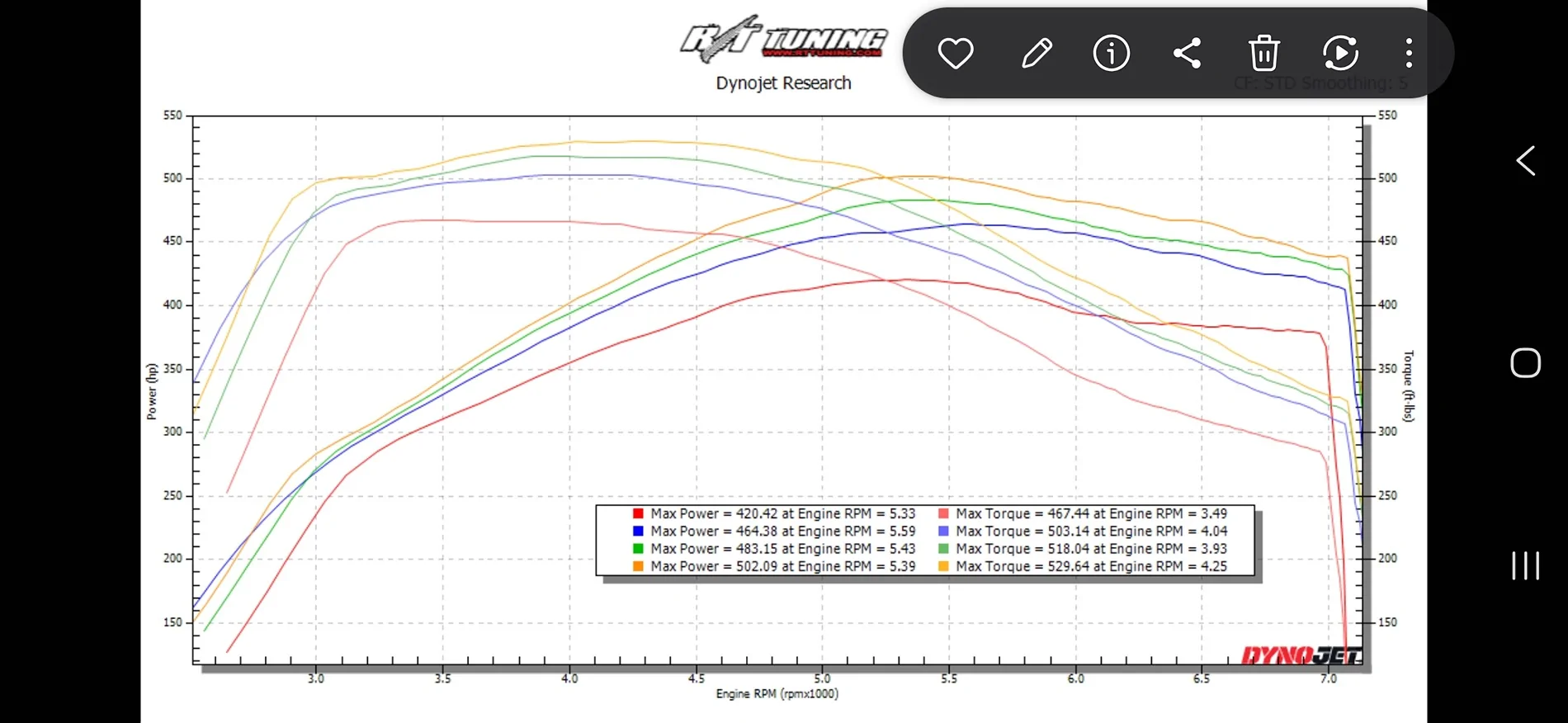
Well here is my custom tune dyno results on pump 93 , and E60. More left on the table for E85. But I wasn't near a gas station with it for appointment.