Sponsored

Add w1 3.3 catch can install.

OP
OP

aurora rz34

Well-Known Member
First Name
Brock
Joined
Aug 19, 2026
Threads
4
Messages
49
Reaction score
26
Location
Pennsylvania
Car(s)
2026 nisaan z heritage edtion
From what I’ve found it’s just a pcv can and not both ccv and pcv
 

VR30Infection

Well-Known Member
Joined
Jul 21, 2024
Threads
0
Messages
538
Reaction score
521
Location
California
Car(s)
24'Z Performance, 67' Barracuda
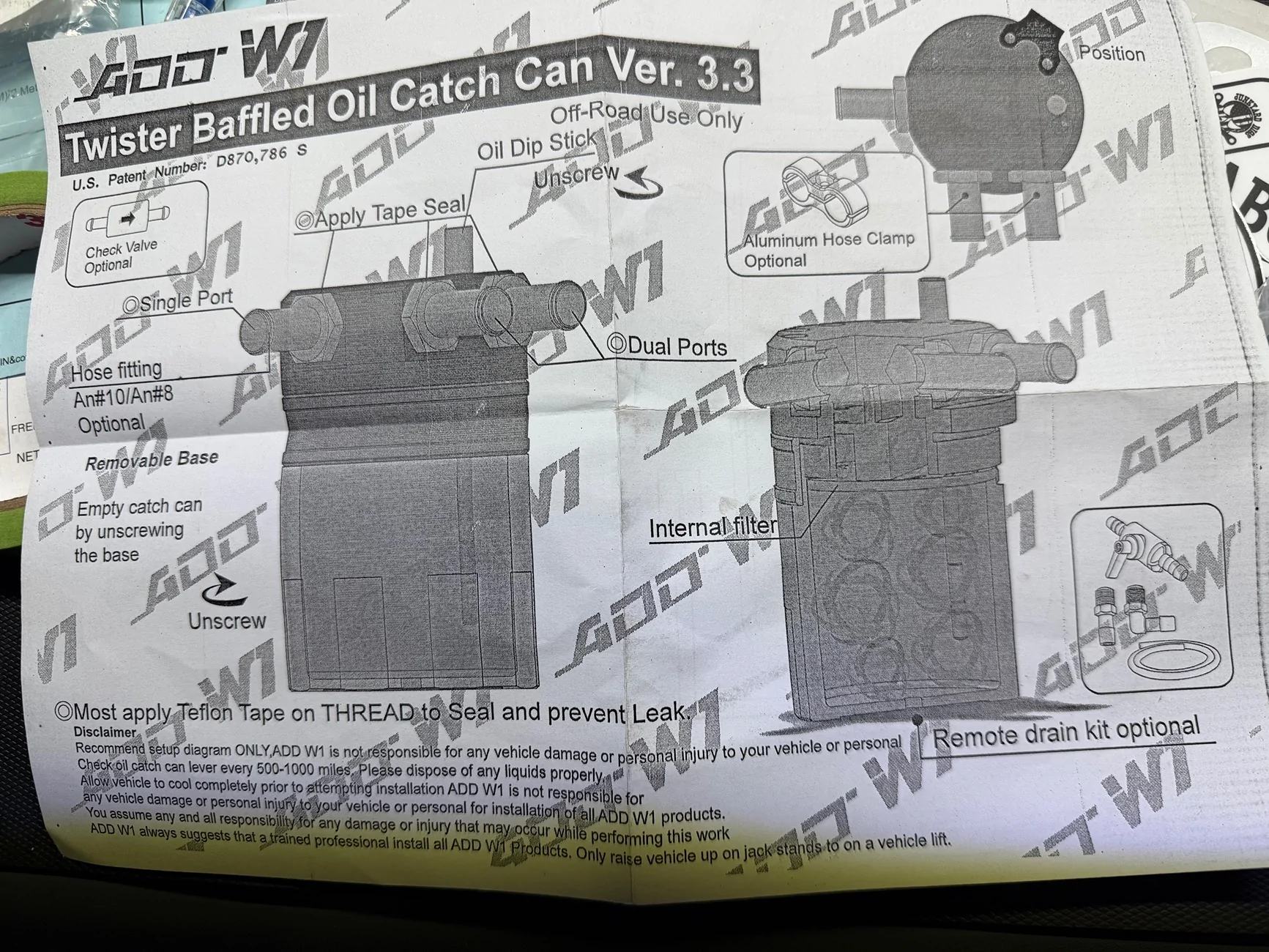
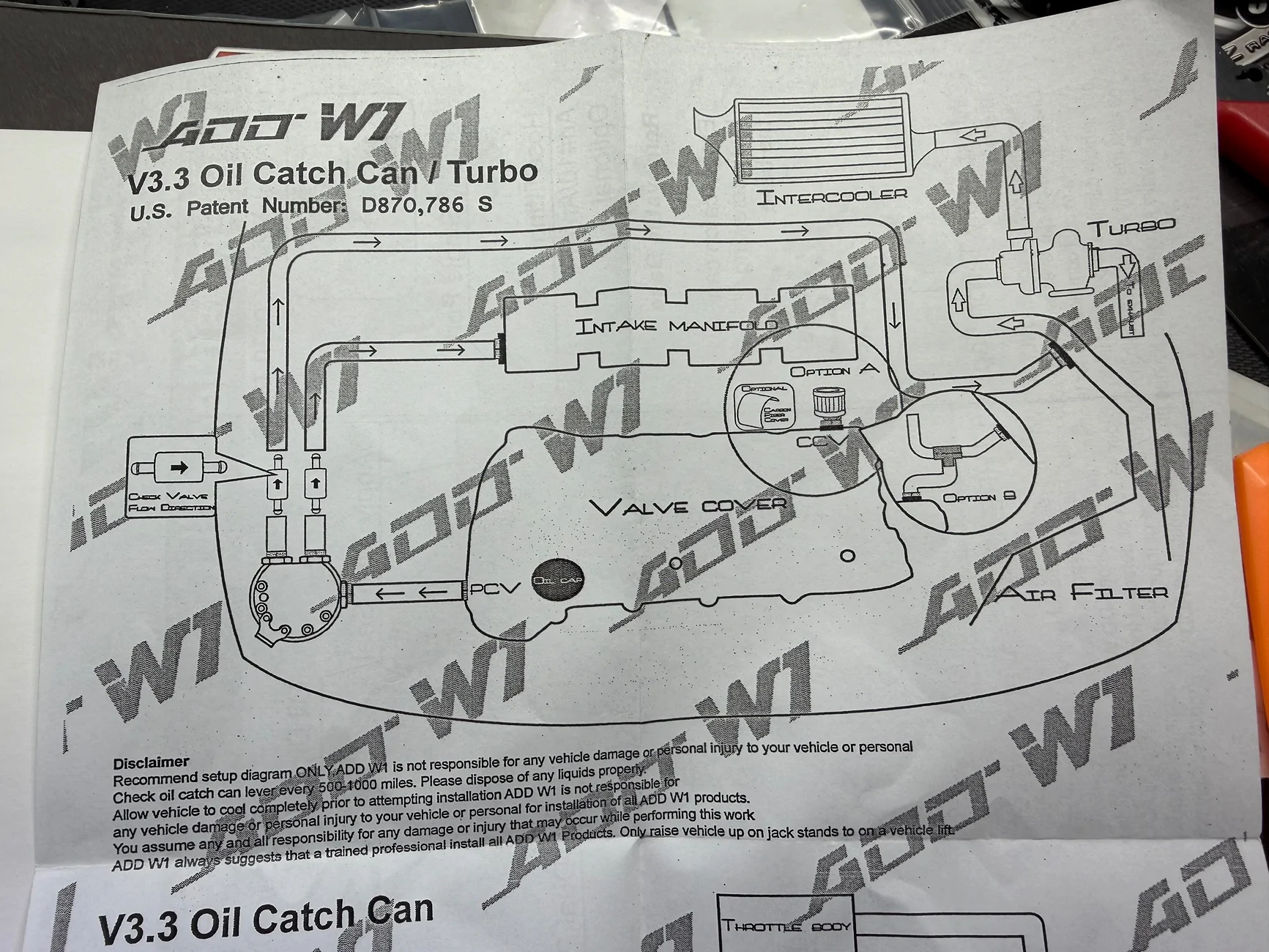
These are the “instructions” that they supply with the kit

IMG_5029.webp


IMG_5030.webp
okay. So based on this design, you would be pulling from the PCV valve always. You would add the check valve on the intake manifold hose with flow going towards the manifold to prevent adding boost to the whole system once the turbos start to spool. The second line would go pre turbo on the passenger side as there is already a hose there. You would have to plug the passenger side valve cover port with a vacuum cap and secure it with a clamp. The only issue I see would be if the PCV becomes a restriction when you’re under boost and there is more blow by caused by the extra combustion chamber pressure.

from the factory our cars pull from the PCV while the manifold is under vacuum. Ie: idle and low load cruising, then while under boost, the PCV is closed and the passenger side takes the job over with a hose from the passenger side valve cover to just in front of the turbo. So while under boost, the turbo is actually helping to excavate the crank case pressure via this unrestricted line. I think it may even be a larger diameter hose but I could be wrong about that as it was like 2 yrs ago when I was staring at everything.

This setup they have designed may be fine but I’m not sure.

personally I take the “better to be safe than sorry” stance.

See, when the car is under vacuum and there isn’t much blow by, meaning, the crank case is not under pressure, the stock system acts like a big loop.

The manifold is under vacuum, sucking the PCV open, but the crank case isn’t feeding it anything, so the air is pulled from the passenger side intake pipe in front of the turbo which has been already metered by the MAF sensor. So the air travels from the passenger side intake pipe, through the crank case port then through the PCV and then to the manifold. So it’s continuously bringing fresh air through the system.
This must be why they have a check valve on that hose to prevent the flow from going backwards and possibly sucking oil out of the catch can if it flows backwards. The only thing with this is you no longer have that fresh air loop. Now, that’s where my knowledge comes to an end. I’m not sure if that really matters or not. Maybe this air loop under low load is pointless. I’m not sure. I just know that this is what it does normally.
I would definitely make some phone calls.
Good luck, I hope it works out well. I definitely want to put an end to the passenger side turbo sucking oil into it, I just haven’t decided what the best route is.
 
OP
OP

aurora rz34

Well-Known Member
First Name
Brock
Joined
Aug 19, 2026
Threads
4
Messages
49
Reaction score
26
Location
Pennsylvania
Car(s)
2026 nisaan z heritage edtion
okay. So based on this design, you would be pulling from the PCV valve always. You would add the check valve on the intake manifold hose with flow going towards the manifold to prevent adding boost to the whole system once the turbos start to spool. The second line would go pre turbo on the passenger side as there is already a hose there. You would have to plug the passenger side valve cover port with a vacuum cap and secure it with a clamp. The only issue I see would be if the PCV becomes a restriction when you’re under boost and there is more blow by caused by the extra combustion chamber pressure.

from the factory our cars pull from the PCV while the manifold is under vacuum. Ie: idle and low load cruising, then while under boost, the PCV is closed and the passenger side takes the job over with a hose from the passenger side valve cover to just in front of the turbo. So while under boost, the turbo is actually helping to excavate the crank case pressure via this unrestricted line. I think it may even be a larger diameter hose but I could be wrong about that as it was like 2 yrs ago when I was staring at everything.

This setup they have designed may be fine but I’m not sure.

personally I take the “better to be safe than sorry” stance.

See, when the car is under vacuum and there isn’t much blow by, meaning, the crank case is not under pressure, the stock system acts like a big loop.

The manifold is under vacuum, sucking the PCV open, but the crank case isn’t feeding it anything, so the air is pulled from the passenger side intake pipe in front of the turbo which has been already metered by the MAF sensor. So the air travels from the passenger side intake pipe, through the crank case port then through the PCV and then to the manifold. So it’s continuously bringing fresh air through the system.
This must be why they have a check valve on that hose to prevent the flow from going backwards and possibly sucking oil out of the catch can if it flows backwards. The only thing with this is you no longer have that fresh air loop. Now, that’s where my knowledge comes to an end. I’m not sure if that really matters or not. Maybe this air loop under low load is pointless. I’m not sure. I just know that this is what it does normally.
I would definitely make some phone calls.
Good luck, I hope it works out well. I definitely want to put an end to the passenger side turbo sucking oil into it, I just haven’t decided what the best route is.
At this point I think I’ll just go the easy route and return this and just pick up a mishimoto catch can for now till radium comes out with one for our cars.
 

VR30Infection

Well-Known Member
Joined
Jul 21, 2024
Threads
0
Messages
538
Reaction score
521
Location
California
Car(s)
24'Z Performance, 67' Barracuda
At this point I think I’ll just go the easy route and return this and just pick up a mishimoto catch can for now till radium comes out with one for our cars.
I hope my explanation wasn’t confusing. I think I agree with that sentiment to be honest. If we knew for sure that the PCV could flow enough during boost, then I think this set up would be fine. We just don’t have that info available, and I don’t think it would be something that anyone would readily have available. If it were a race car, then I would say just go with a double vent to atmosphere setup. That’s what’s done on GTR’s.


Top